

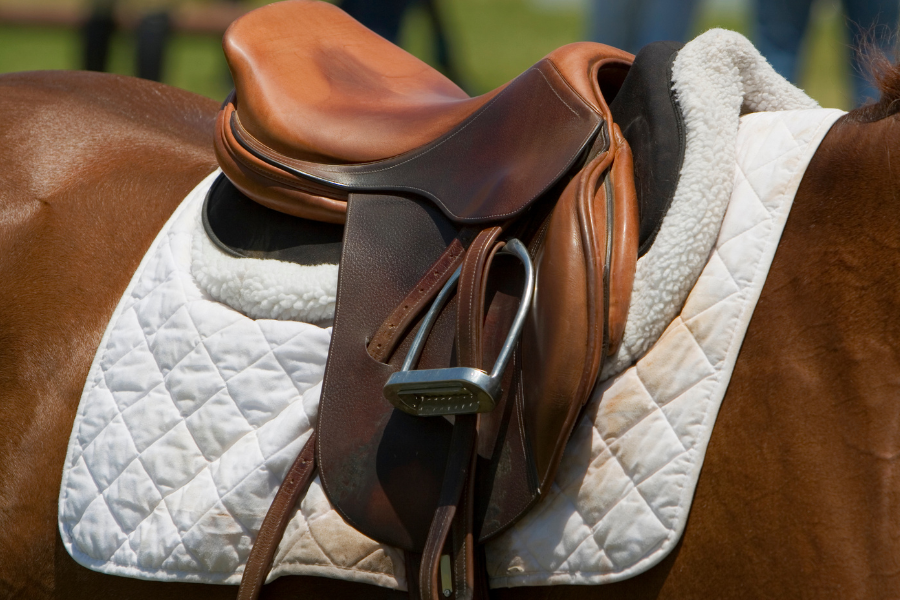
Why Does Saddle Fit Matter?
A saddle distributes the rider's weight across the horse's back. When the fit is appropriate, pressure should be distributed evenly without restricting the shoulders, spine or withers.
Poor saddle fit may create concentrated pressure or unwanted movement. Over time, this can contribute to rubbing, soreness or changes in the way a horse moves.
Good saddle fit for horses is therefore part of routine preventative care, alongside hoof care, dentistry, appropriate conditioning and regular health checks.
How to Fit a Horse Saddle: The Basics
Professional saddle fitting involves much more than a quick visual check, but understanding a few basic principles can help owners recognise when something deserves closer attention.
1. Correct Positioning
The saddle should sit in the correct position behind the horse's shoulder rather than being placed too far forward.
Positioning it incorrectly can restrict shoulder movement and affect how the saddle balances.
Avoid automatically placing the saddle where it "looks right". Different horses have different back and shoulder shapes, which can change where a saddle naturally belongs.
2. Wither Clearance
There should be appropriate clearance around the withers so the saddle does not press directly against them.
Clearance needs to be considered around the sides of the withers as well as above them. It should also be assessed once the girth is secured and the rider is in the saddle, as the amount of space can change under weight.
3. Even Contact
Ideally, the saddle should distribute pressure evenly along the appropriate areas of the horse's back.
Uneven contact may result in excessive pressure in certain areas. For example, a saddle may make contact at the front and back while leaving insufficient contact through the middle.
Because pressure distribution can be difficult to assess accurately yourself, this is one area where an experienced saddle fitter can be particularly valuable.
4. Balance
A saddle should sit in balance rather than tipping noticeably forwards or backwards.
Balance matters for both horse and rider. If the rider is constantly being pushed forwards, backwards or into an unnatural position, the saddle may need further assessment.
5. Stability
The saddle should feel stable without excessive rocking, slipping or movement from side to side.
However, simply tightening the girth to stop movement isn't a solution to an underlying horse saddle fit problem. Persistent movement should be investigated.
Signs of Poor Saddle Fit
Knowing the signs of poor saddle fit can help owners identify concerns before they become bigger problems.
Possible warning signs include:
- Rubbed or broken hair beneath the saddle
- Swelling or tenderness along the back
- Areas that appear unusually sensitive to touch
- Pressure marks
- Persistent saddle movement or slipping
- Reluctance when being saddled or girthed
- Changes in stride or freedom of movement
- Difficulty moving comfortably through the shoulders
- Unexpected changes in ridden performance
- Reluctance to move forward, bend or perform familiar exercises
- Changes in behaviour during or after riding
These signs don't automatically mean the saddle is responsible. Back pain, lameness, dental problems, hoof issues, injury and other health conditions can also affect movement and behaviour.
Rather than assuming a behavioural change is a saddle problem, look at the horse as a whole and seek professional advice where appropriate.
Check Your Horse After Riding
Regular observation can help you identify changes.
When removing the saddle, check your horse's back for unusual swelling, tenderness, rubs or areas of sensitivity. You can also take note of how your horse moves before, during and after exercise.
Sweat patterns may provide some information, but they shouldn't be used alone to determine whether a saddle fits correctly.
If your horse repeatedly shows discomfort or develops unexplained changes in movement or performance, speak with your veterinarian and saddle fitter.
Saddle Fit Should Be Checked With a Rider
One common mistake when fitting a saddle to your horse is assessing it only while the horse is standing still.
A saddle that appears suitable in the stable may behave differently once the horse is moving and carrying weight.
The rider also affects saddle balance and pressure distribution. Rider size, position and balance can influence how the saddle interacts with the horse's back.
For this reason, a thorough assessment should ideally consider the horse:
- Standing without a rider
- With the saddle appropriately girthed
- Carrying the rider
- Moving through different paces where appropriate
This gives a more realistic picture of how the saddle performs during actual use.
What About Western Saddle Fitting?
The same overall goal applies to western saddle fitting: distributing pressure appropriately while allowing comfortable, unrestricted movement.
However, western saddles differ considerably in their construction and weight-bearing surface, so they have their own fitting considerations.
Tree shape and angle, bar contact, gullet clearance, positioning and stability all need to suit the individual horse.
If you regularly ride western, working with someone experienced specifically in western saddle fitting is worthwhile rather than applying English saddle fitting principles directly.
Saddle Fit Changes Over Time
Saddle fitting for horses isn't a one-time task.
Your horse's body can change considerably throughout its life due to:
- Age
- Weight gain or loss
- Changes in workload
- Muscle development
- Fitness and conditioning
- Time away from work
- Injury or rehabilitation
- Seasonal changes
A young horse developing muscle, for example, may change shape relatively quickly. Similarly, a horse returning to work after a long break may develop a different topline as fitness improves.
This means a saddle that fitted well previously may not continue to fit indefinitely.
Regular reassessment is particularly worthwhile after significant changes in weight, condition or workload.
When Should You Call a Saddle Fitter?
Consider arranging a professional assessment if you notice persistent saddle movement, pressure marks, soreness or unexplained changes in your horse's comfort or ridden performance.
It is also sensible to reassess fit after major physical changes or when purchasing a new saddle.
If your horse appears painful, lame or physically unwell, involve your veterinarian as well. A saddle fitter can assess equipment, but veterinary investigation may be necessary to identify or rule out underlying medical causes.
Make Saddle Fit Part of Preventative Horse Care
Good horse saddle fitting is about more than comfort during a single ride. Regularly checking fit can help identify changes early and reduce the likelihood of avoidable saddle-related discomfort.
Pay attention to positioning, wither clearance, even contact, balance and stability, while remembering that saddle fit should ultimately be assessed with the horse moving and carrying a rider.
Preventative care can reduce some risks, but horses can still experience unexpected injuries or require veterinary treatment. Planning ahead for these situations can make difficult decisions easier when they arise.
For owners considering financial protection against eligible unexpected veterinary costs, you can learn more about Pet-n-Sur horse insurance here.
Most importantly, if you're uncertain about your horse saddle fit, don't rely on a checklist alone. A qualified and experienced saddle fitter can assess your individual horse, saddle and rider together — helping keep comfort, safety and long-term wellbeing at the centre of every ride.